Did you know that delegates of overseas Koreans known as the Korean Congress declared Korea’s independence in Philadelphia in 1919? Inspired by the American Declaration of Independence in 1776, the Korean Congress was modeled after the Second Continental Congress and gathered in Philadelphia to declare their independence from Japan.
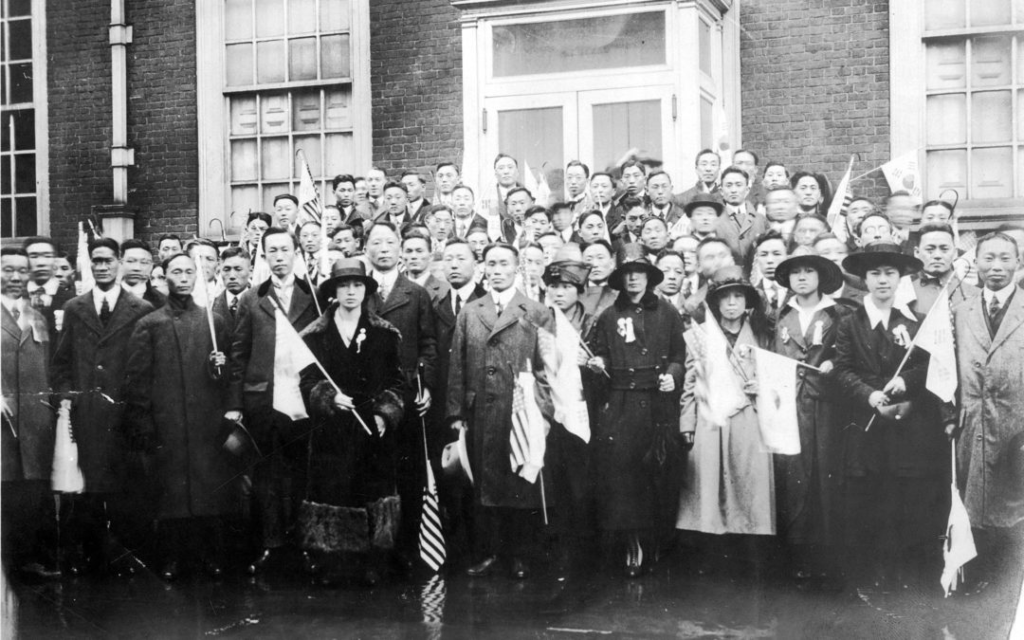
Korean delegates in Philadelphia, April 14-16, 1919.
Dr. Seo Jae Pil (aka Philip Jaisohn) organized the meeting of the Korean Congress, composed of around 150 delegates from the Korean diaspora in the U.S. and around the world. The three-day event, from April 14 to 16, 1919, took place in the Little Theatre at 17th and Delancey Street in Philadelphia. The gathering constituted the first collective response of the overseas Koreans to the news of the March 1st Movement in Korea. Aside from the Korean delegates, many prominent American guests and members of the media were in attendance. The main purpose of the Korean Congress was to rally the support of the Americans and the international community for Korea’s independence. For that reason, the entire proceedings were conducted in English.
During the event, participants listened to speeches and joined in discussions that exposed the political and social repression of the Korean people under Japanese colonial rule. Then they marched through the city of Philadelphia, ending at Independence Hall, where the Korean Congress read and affirmed the text of the Proclamation of Independence of Korea. This was the same Proclamation that was read by the leaders of the March 1st Movement on March 1, in Seoul.
Around this time, Dr. Seo Jae Pil also started serving as the head of the Korean Information Bureau in Philadelphia. The Bureau served as the public relations office to promote Korea’s independence. Among numerous public relations efforts, the Bureau organized the “Friends of Korea” society composed of more than 100 prominent Americans who were vocal advocates for the independence movement. According to Warren Kim, an early Korean immigrant historian, the Friends of Korea society “helped the Korean movement tremendously”.
The Korean Congress also resolved to seek the U.S.’s recognition of the Korean Provisional Government as the official government in exile for all Korean people. In September, 1919, a consolidated Provisional Government of the Republic of Korea (“KPG”) was established. It was headquartered in Shanghai, China, with Rhee Syngman serving in Washington D.C. as the first President of KPG. The KPG was governed by a constitution, and with a 39-member national assembly representing 13 provinces of Korea and those overseas Koreans living in the U.S., China, Siberia, Manchuria and Hawaii.